B Is for Bus: A Vibrant, Educational Embroidery Design for Alphabet Quilts and Early Learning
When early literacy meets tactile creativity, the result is more than just a craft project—it’s a developmental milestone. B is for Bus exemplifies this intersection beautifully. As part of the broader Boy-themed alphabet quilt series, this machine embroidery design transforms a simple letter into a multisensory learning tool—engaging sight, touch, and narrative imagination all at once. Unlike static flashcards or digital apps, B is for Bus invites hands-on interaction: stitching it onto fabric, layering it into a quilt block, or incorporating it into classroom decor. Its dual role—as both an educational anchor and a charming visual motif—makes it especially valuable across diverse settings: home sewing rooms, Montessori classrooms, therapeutic occupational therapy sessions, and even small-batch children’s apparel businesses.
Why “B Is for Bus” Resonates Across Age Groups and Contexts
The choice of “bus” as the representative word for B is intentional and deeply functional. Buses are universally recognizable to young children—not abstract or culturally niche like “bison” or “belfry.” They appear in daily life (school routes, city transit), storybooks (The Magic School Bus, Don’t Let the Pigeon Drive the Bus!), and imaginative play. This familiarity lowers cognitive load during letter recognition, allowing learners to focus on phonemic awareness (“/b/” sound) without decoding unfamiliar vocabulary. For educators, that means B is for Bus supports evidence-based early literacy strategies: consistent sound-symbol pairing, contextual reinforcement, and repetition through varied modalities.
But its utility extends beyond preschoolers. Older children with language delays or autism spectrum profiles often benefit from concrete, high-contrast visual cues paired with motor engagement—exactly what embroidery provides. The physical act of hooping fabric, selecting thread colors, and watching the machine render the bus shape builds fine motor coordination while reinforcing letter identity. Even adults find grounding in the rhythmic precision of embroidery—a quiet counterpoint to screen-saturated routines.
Design Features That Support Real-World Use
What sets B is for Bus - Part of the Boy-themed alphabet quilt apart isn’t just thematic cohesion—it’s technical adaptability. The design ships in multiple embroidery file formats (.dst, .pes, .jef, .exp, .vp3, .xxx), ensuring compatibility across major home and commercial machines: Brother, Janome, Bernina, Husqvarna Viking, and Baby Lock. This cross-platform readiness removes a common friction point for hobbyists upgrading equipment or educators sharing resources across school labs with mixed-brand setups.
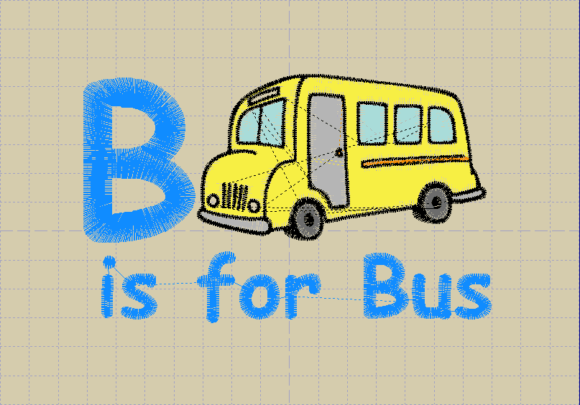
The artwork itself balances clarity with charm. The bus is drawn with bold outlines and simplified features—large wheels, rectangular windows, a friendly grille—that translate cleanly at stitch counts appropriate for 4–6 inch quilt blocks. No tiny details get lost in thread tension or fabric weave. It includes optional elements: a subtle “B” inside the bus window (reinforcing letter placement), and scalable sizing presets (3.5”, 4.75”, and 5.8” wide) so users can match existing quilt grids or adjust for wall hangings versus lap quilts.
Color suggestions are provided—not as rigid directives, but as thoughtful palettes grounded in developmental research. High-contrast combinations (navy bus on yellow background, red bus on white linen) enhance visual discrimination for emerging readers. Softer variants (mint bus on oatmeal cotton) suit sensory-sensitive environments where overstimulation is a concern. These aren’t arbitrary aesthetics; they’re accessibility features stitched into the design’s DNA.
Practical Applications Beyond the Quilt Frame
While conceived for the Boy-themed alphabet quilt, B is for Bus thrives far outside traditional quilting contexts. Here’s how different users bring it to life:
- Hobbyists and Makers: Stitch it onto denim lunchbox totes, personalize backpack patches, or appliqué it onto nursery curtains. One textile artist used scaled-down versions to create a “bus-shaped” memory book cover for a child’s first day of kindergarten—each window holding a photo from a different milestone.
- Educators: Mount embroidered blocks on corkboards for interactive word walls. Laminate them for wipe-clean phonics games (“Match the bus to the /b/ sound card”). In bilingual classrooms, pair the bus with labels in English and Spanish (“Bus / Autobús”) to support dual-language development.
- Therapists and Special Educators: Integrate the design into sensory bins—stitch it onto textured fabrics (corduroy wheels, felt smokestacks) to build tactile vocabulary. Use the embroidery hoop itself as a motor planning tool: “Place the blue thread in the hoop before starting,” scaffolding executive function skills.
- Small Business Owners: Boutique童装 brands use B is for Bus to create limited-run organic cotton rompers with embroidered letter motifs—marketing them not just as apparel, but as “wearable literacy tools.” Craft supply retailers bundle it with coordinating thread kits and ABC-themed stabilizers, turning a single design into a cross-category revenue stream.
Material and Workflow Considerations for Consistent Results
Embroidery success hinges less on complexity and more on thoughtful preparation—and B is for Bus rewards attention to detail. Lightweight cotton or linen works best for crisp stitch definition; heavier twills or knits may require cutaway stabilizer to prevent puckering around the bus’s straight edges and wheel curves. When digitized correctly—as this design is—the underlay stitches secure the fabric before the main motif lays down, minimizing shifting during the long satin-stitched roof line or dense fill of the body.
Thread choice also impacts function. Polyester thread offers durability for items that will be washed repeatedly (like quilt squares or toddler bibs), while cotton floss lends a softer hand for wall art or keepsake pillows. For classrooms, educators report better longevity using 40-weight thread instead of finer 60-weight—especially when children handle finished pieces. And because the design avoids excessive jump stitches or trims, it runs smoothly on older machines with slower processing speeds—a practical advantage often overlooked in digital pattern libraries.
Connecting Literacy, Craft, and Community
At its core, B is for Bus participates in a larger movement: reclaiming handmade objects as vessels for meaning-making. In an era where mass-produced learning tools dominate, a quilt block stitched by a grandparent, a teacher, or a child themselves carries irreplaceable emotional weight. One homeschooling parent described assembling the full alphabet quilt over nine months—each letter introduced alongside a real-world experience (“We rode the bus to the library for B!”). That associative learning—anchored in movement, memory, and materiality—sticks longer than rote repetition ever could.
Community makerspaces have adopted B is for Bus - Part of the Boy-themed alphabet quilt as a collaborative starter project. Teens teach seniors to use embroidery software; neurodivergent youth lead workshops on “letters that move”—using toy buses to demonstrate initial sounds while stitching their own. These aren’t just craft sessions; they’re intergenerational, cross-ability literacy events disguised as creative play.
Looking Ahead: Sustainability and Scalability
As interest grows in slow-made, low-waste education tools, designs like B is for Bus gain renewed relevance. Digital files eliminate shipping emissions and plastic packaging. When stitched onto upcycled fabrics—old denim jackets, thrifted flannel shirts, or leftover quilt scraps—they transform waste into pedagogical assets. Some libraries now lend embroidery machines alongside early literacy kits, including pre-loaded B is for Bus files, lowering access barriers for families without home equipment.
Future iterations could expand inclusivity: alternate vehicle options (e.g., “B is for Bicycle” or “B is for Boat”) to reflect diverse transportation experiences, or add braille overlays for visually impaired learners. But even in its current form, B is for Bus demonstrates how a single, well-considered design can serve layered purposes—teaching phonics, building motor skills, sparking conversation, and honoring the quiet dignity of making something by hand.
Final Thought: More Than Just a Letter
“B is for Bus” does not merely name an object. It invites action: boarding, departing, arriving. It implies motion, community, routine, and discovery. When translated into thread and fabric, it becomes a tangible metaphor for learning itself—structured yet flexible, guided yet open-ended, small in scale but expansive in impact. Whether stitched onto a quilt square passed down through generations or pinned to a classroom bulletin board beside a child’s first attempt at writing the letter B, it holds space for growth. That’s the quiet power of thoughtful design: not to dazzle, but to accompany—to be there, steadily, as learning unfolds, one bus, one stitch, one letter at a time.